
Number Reputation Management: A Contact Center Playbook
Number Reputation Management: A Contact Center Playbook
Run a number audit today. Contact a platformed provider that offers cross-carrier monitoring, STIR/SHAKEN attestation, CNAM registration, and remediation workflows. That single move protects your answer rates faster than any dialing script change.
Your next 24–72 hours:
- Audit your top-performing numbers across carriers and analytics apps (Hiya, First Orion, TNS) to confirm how they display
- Pause any number showing a “Spam Likely” or “Scam” label immediately
- Confirm STIR/SHAKEN attestation status on your outbound lines
- Submit CNAM registration for any number missing a business identity display
- Open remediation requests with your carrier or analytics provider for flagged numbers
Vendor shortlist by primary use case:
- Revring — integrated dialer, monitoring, and compliance automation in one platform
- Five9 — enterprise CCaaS with identity management built into the contact-center stack
- Bandwidth — carrier-depth provisioning and number lifecycle control
- TNS — cross-carrier analytics and clearinghouse-level remediation pathways
- Numeracle — remediation-first specialist with active carrier dispute workflows
- Caller ID Reputation — real-time monitoring and fast flagging alerts
Key Takeaways
Number reputation management is an ongoing operational infrastructure discipline, not a one-time fix, and the contact centers that sustain high answer rates combine preventative controls (STIR/SHAKEN, CNAM) with continuous monitoring and active remediation.
| Point | Details |
|---|---|
| Start with an audit | Check label status across carriers and analytics apps before any remediation action. |
| Prevention beats cure | Register CNAM and confirm STIR/SHAKEN Level A attestation before a label problem develops. |
| Volume controls matter | Keep dials low per number per day and maintain at least 3 numbers per area code for rotation. |
| Track the right KPIs | Monitor answer rate, connection rate, blocked call rate, and time-to-remediation continuously. |
| Revring integrates it all | Revring combines dialer, monitoring, AI automation, and compliance in one subscription for faster remediation loops. |
Table of Contents
- What is number reputation management?
- How does number reputation management actually work?
- Why does caller ID reputation directly affect your contact rates?
- How do you choose the right number reputation management provider?
- Practical remediation steps you can start today
- Which vendors should you evaluate for number reputation management?
- How Revring handles number reputation management inside the platform
- How long does implementation take, and what does it cost?
- How do vendors actually get spam labels removed?
- An honest take on where most contact centers go wrong
- Revring gives you one platform to manage it all
- Sources
What is number reputation management?
Number reputation management is the operational discipline of monitoring, protecting, and restoring the trust signals carriers and analytics providers assign to your outbound phone numbers. It covers every layer between your dialer and the recipient’s screen: CNAM display, STIR/SHAKEN attestation, spam-label analytics, call-volume controls, and dispute workflows.
Caller ID reputation is a dynamic trust score that carriers and analytics engines assign based on signals including call volume, pickup rate, call duration, spam complaints, CNAM presence, STIR/SHAKEN status, number age, and area code relevance. When that score drops, carriers and apps like Hiya or First Orion label your calls “Spam Likely” before a single word is spoken.
The scope of a managed program typically includes:
- Continuous cross-carrier monitoring and label detection
- CNAM and business-identity registration
- STIR/SHAKEN attestation management
- Number rotation, throttling, and pool sizing
- Remediation and dispute workflows with analytics aggregators
- DNC and consent-hygiene enforcement
- Dashboards, alerts, and API hooks for dialer and CRM integration
In most contact centers, this function sits at the intersection of the dialer layer and the compliance team. Larger enterprises often delegate it to a managed vendor; mid-market teams increasingly use platformed solutions that automate the monitoring and remediation loop inside the dialer itself.
How does number reputation management actually work?
The mechanics follow a signal-collection-to-action loop. Your predictive dialer sends calls through the carrier network, which applies STIR/SHAKEN attestation at the origination layer. Third-party analytics aggregators — Hiya, First Orion, and TNS — collect behavioral signals from that call traffic and assign labels. Those labels surface on the recipient’s device as a branded caller ID, a neutral display, or a spam warning.
Core capabilities a complete program requires:
- Cross-carrier monitoring: Continuous scanning across major carriers and analytics databases to catch label changes before they compound
- CNAM registration: Registering your business name so recipients see a recognizable display rather than a raw number
- STIR/SHAKEN attestation: Cryptographic call-signing at the origination layer; Level A attestation is the strongest signal of legitimate identity
- Auto-rotation and throttling: Distributing call volume across a number pool to prevent any single number from hitting complaint thresholds
- Remediation and dispute workflows: Submitting correction requests to analytics providers and carriers when mislabeling occurs
- Dashboards and alerts: Real-time visibility into label status, flagged numbers, and answer-rate trends
- Integration hooks: API connections to dialers, CCaaS platforms, and CRMs so number-health signals trigger automated operational responses
The measurement flow runs like this: outbound dialer sends calls, the carrier and attestation layer signs them, analytics aggregators score the behavioral signals, the device or OS renders a label, and the monitoring platform detects any negative label change and triggers a remediation loop. STIR/SHAKEN and spam-remediation programs are complementary: attestation is preventative, remediation is corrective. Running both together produces better results than either alone.
Pro Tip: Assign each number to a single campaign purpose. Cross-contamination between a high-volume prospecting campaign and a lower-volume appointment-confirmation line is one of the fastest ways to drag down a clean number’s reputation.
Why does caller ID reputation directly affect your contact rates?
A spam label is a conversion killer before the call connects. When a number is flagged, answer rates drop, which means the number gets answered less, which means its behavioral score worsens further. TNS reporting confirms that enterprises continue to face mislabeling and that active monitoring and remediation help reduce it and improve answer rates. The decay cycle is self-reinforcing: a flagged number answered less often scores worse, which generates more flags.
KPIs to track for your program:
- Answer rate (calls answered / calls placed)
- Connection rate (live conversations / dials)
- Voicemail rate (voicemails left / total dials)
- Complaint and opt-out rate
- Blocked call rate
- Time-to-remediation (hours from flag detection to label removal)
Vendor monitoring and remediation services can detect flagged caller IDs in real time and report rapid reductions in flags after active remediation, though results vary by program quality and starting condition.
| Operational benchmark | Typical guidance | Notes |
|---|---|---|
| Max calls per number per day | ~50 calls/number/day | Exceeding this accelerates complaint accumulation |
| Minimum numbers per area code | a recommended minimum count of numbers per area code to support healthy rotation | Supports healthy rotation without overloading any single line |
| CNAM propagation window | Days to weeks | Carrier opt-in and propagation vary |
| Remediation turnaround | 1–30 days | Depends on aggregator and carrier responsiveness |
How do you choose the right number reputation management provider?
Speed matters here. Use this checklist to qualify vendors in a single discovery call.
Must-have capabilities:
- Cross-carrier monitoring with real-time label detection across major carriers and analytics databases
- STIR/SHAKEN support, including Level A attestation and origination-layer signing
- CNAM registration and business-identity management
- Active remediation workflows with named analytics aggregators (Hiya, First Orion, TNS)
- API access so number-health signals can trigger automated dialer responses
- Native or documented integration to your dialer, CCaaS platform, or CRM
- Written SLA terms for remediation turnaround and escalation paths
Questions to ask vendors during discovery:
- Which carriers and analytics aggregators do you have direct relationships with?
- What is your committed remediation SLA, and what happens when a label persists beyond it?
- How long do you retain call-health and label-history data, and what reporting do you provide?
- What API endpoints do you expose for number-health signals, and which dialers or CCaaS platforms have you integrated with?
- Can you share documented case outcomes showing answer-rate lift or flag-reduction metrics?
Red flags to walk away from:
- No visibility into specific carriers or aggregators (only “we monitor the network”)
- No written remediation SLA or escalation path
- No API for number-health signals
- Opaque per-remediation pricing with no cap or estimate
- Refusal to share any case outcomes or measured impact data
Practical remediation steps you can start today
You do not need a vendor contract to begin. These steps are executable now.
- Audit label display: Call your own numbers from multiple carrier lines and check display in Hiya, First Orion, and Google’s spam database. Screenshot every result with a timestamp.
- Collect evidence: Document the label, the carrier, the date, and the call volume history for each flagged number. Aggregators want this when you submit disputes.
- Submit remediation requests: Use carrier portals and aggregator dispute forms directly. TNS, Hiya, and First Orion each maintain submission pathways for business callers.
- Pause or throttle flagged numbers: Pull flagged lines from active rotation immediately. Continued dialing on a flagged number deepens the score damage.
- Ramp replacement numbers methodically: Improving caller ID reputation requires auditing display, registering business identity, using numbers consistently by purpose, ramping gradually, and keeping contact data clean. Start new numbers at low volume (10–20 calls/day) and increase over two to three weeks.
- Update CNAM and identity records: Register your business name with your carrier or a CNAM provider. CNAM approval often takes a few business days; full propagation across carriers can take several weeks.
- Enforce list hygiene: Suppress DNC and opt-out records before every campaign run. Remove stale or wrong-party numbers that generate high complaint rates. Document consent source for every contact.
Pro Tip: When submitting a remediation request to an analytics aggregator, include your STIR/SHAKEN attestation status, your CNAM registration confirmation, and a call-volume summary for the past 30 days. Aggregators respond faster to requests that demonstrate legitimate business identity upfront.
Which vendors should you evaluate for number reputation management?
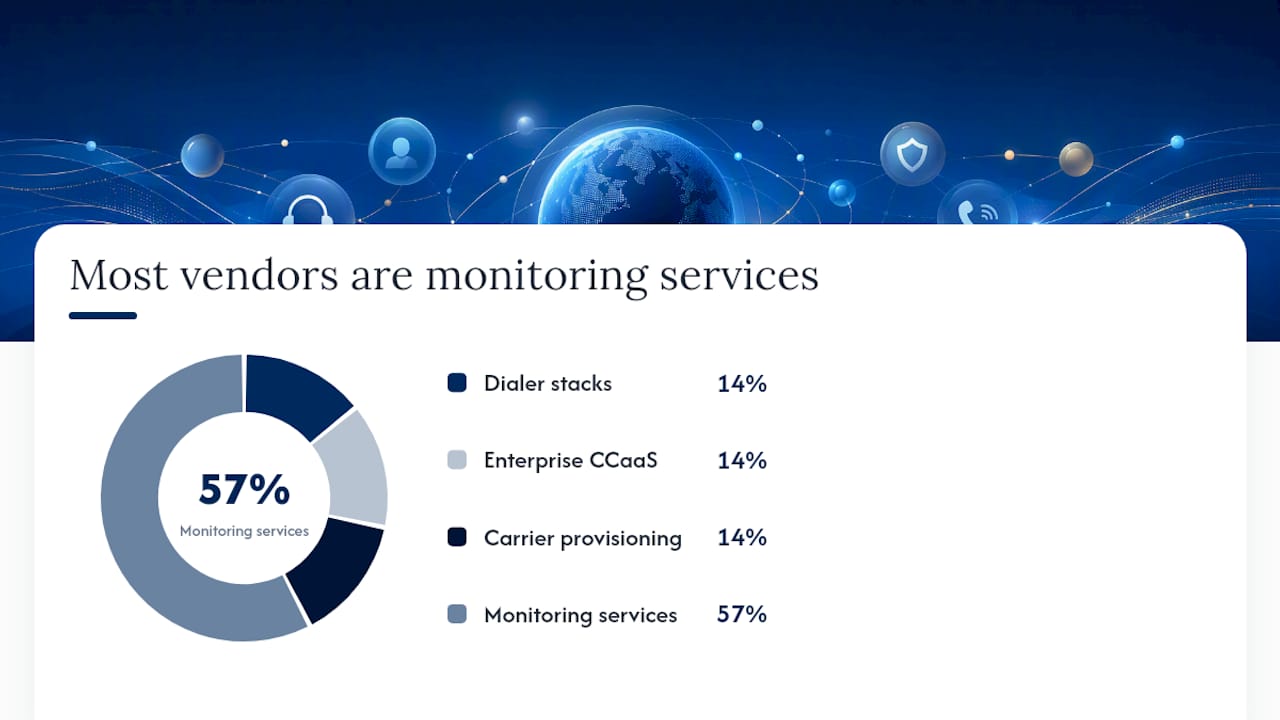
The market breaks into four functional categories: platformed dialer stacks with built-in reputation controls, enterprise CCaaS vendors with identity features, carrier-layer provisioning specialists, and dedicated reputation-monitoring services. Here is how the main options map to those categories.
| Vendor | Best for | Core features | STIR/SHAKEN & carrier partnerships | Dialer / CCaaS integration | Remediation SLAs | Pricing model |
|---|---|---|---|---|---|---|
| Revring | Contact centers needing dialer + monitoring + compliance in one subscription | Predictive dialer, number rotation, AI automation, TCPA/DNC/HIPAA compliance, CRM | STIR/SHAKEN support within platform; carrier connectivity via telephony layer | Native: dialer, CRM, AI scoring, workflow automation | Platform-managed remediation workflows | Seat-based SaaS; usage add-ons |
| Five9 | Enterprises already on a full CCaaS stack | CCaaS suite, outbound dialing, identity management | Enterprise carrier integrations | Native CCaaS; broad CRM connectors | Vendor-managed; SLA terms vary by contract | Enterprise contract |
| Bandwidth | Teams needing deep carrier provisioning | Number provisioning, CNAM, carrier connectivity, number lifecycle | Direct carrier relationships | API-first; integrates with CCaaS and dialers | Provisioning-layer controls; remediation via carrier paths | Usage-based telephony |
| TNS | Cross-carrier analytics and mislabeling insights | Analytics clearinghouse, label monitoring, reporting | Strong aggregator and carrier relationships | API and reporting integrations | Carrier-facing remediation pathways | Enterprise analytics licensing |
| Numeracle | Dedicated remediation and carrier dispute management | Remediation workflows, registration, carrier dispute management | Active aggregator and carrier dispute relationships | Integration with major dialers | Remediation-first SLA focus | Service-based; varies |
| Caller ID Reputation | Monitoring-first SaaS for fast flag detection | Real-time monitoring, flagged-ID alerts, audit reporting | Cross-carrier monitoring | SaaS dashboard; API available | Alert-driven; remediation coordination | SaaS subscription |
| Klenty | Sales teams wanting dialing hygiene inside outreach sequences | Caller-ID signal documentation, outreach integration, hygiene guidance | Operational guidance; not a carrier-layer tool | Native sales outreach platform | Operational guidance; no dedicated remediation SLA | Sales platform subscription |
Revring is the only option in this group that combines the dialer, number-rotation logic, AI automation, and compliance infrastructure in a single subscription. That matters operationally: when the monitoring signal and the dialer action live in the same platform, the remediation loop closes faster than it does when you are coordinating between a separate monitoring vendor and a separate dialer.
Five9 suits enterprises already committed to a full CCaaS deployment. Bandwidth is the right choice when your primary need is carrier-layer provisioning depth and number lifecycle control rather than a managed reputation program. TNS provides the strongest cross-carrier analytics signal, which makes it valuable as a data layer even when another vendor handles remediation. Numeracle focuses almost entirely on remediation and carrier disputes, a strong fit for organizations with a complex existing number portfolio. Caller ID Reputation offers fast, monitoring-first alerting for teams that want visibility before they invest in a full managed service. Klenty documents caller-ID signals and provides operational guidance inside a sales outreach platform, but it is not a carrier-layer or remediation tool.
How Revring handles number reputation management inside the platform
Revring applies monitoring, CNAM registration, STIR/SHAKEN attestation, number rotation, and remediation inside a single platform workflow rather than requiring separate vendor relationships for each function. The AI and automation layer monitors number health continuously, flags anomalies, and can trigger throttling or rotation automatically based on configurable thresholds.
Implementation playbook:
- Week 1 — Audit: Pull all active numbers, check label status across carriers and analytics apps, document CNAM and STIR/SHAKEN status for each line
- Week 1–2 — Register: Submit CNAM registrations for unregistered numbers; confirm STIR/SHAKEN Level A attestation on origination lines
- Week 2 — Throttle and rotate: Set per-number daily call limits within the dialer; activate number-rotation pools sized to your call volume (minimum three numbers per area code)
- Week 2–3 — Remediate: Submit dispute requests for flagged numbers through platform-managed workflows; pause flagged lines from active campaigns
- Ongoing — Monitor: Use the platform dashboard to track answer rate, connection rate, and label status; set alerts for any number crossing a complaint threshold
Teams in regulated industries, including healthcare and insurance, benefit from the compliance infrastructure built into the same subscription: TCPA controls, DNC suppression, and HIPAA BAA support run alongside the number-health layer rather than as a separate compliance stack.
Pro Tip: Involve your compliance officer in the audit phase, not just the remediation phase. Consent documentation and DNC hygiene gaps are often the root cause of complaint-driven labels, and fixing them upstream prevents the next remediation cycle.
Expected checkpoints: measurable label reduction within two to four weeks of active remediation; answer-rate improvement visible in dashboard metrics within 30–60 days depending on program starting condition and carrier responsiveness.
How long does implementation take, and what does it cost?
| Phase | Typical timeline | Notes |
|---|---|---|
| Number audit | 1–3 days | Faster with a platformed tool; manual audits take longer |
| CNAM registration | A few business days for approval; 2–4+ weeks for full propagation | Carrier opt-in and propagation vary |
| STIR/SHAKEN attestation | Days to weeks depending on origination provider | Level A requires verified business identity |
| Remediation turnaround | 1–30 days per number | Aggregator responsiveness varies significantly |
| Measurable answer-rate lift | 30–60 days from program start | Depends on starting condition and remediation volume |
Cost drivers to budget for:
- Number pool size: more numbers in rotation means more per-number registration and monitoring costs
- Per-number CNAM registration fees (carrier and upstream provider rates vary)
- Remediation service fees if using a managed vendor (per-number or subscription)
- Integration and custom API work if your dialer is not natively supported
- Human operations time for audit, evidence collection, and dispute submission
ROI framing: The payback calculation is straightforward. If your contact center places 10,000 dials per day and a spam label suppresses answer rates by even a few percentage points, the lost conversations compound quickly into missed pipeline. Estimate your current answer rate, apply a conservative lift assumption from remediation (program quality and starting condition determine the actual range), and calculate the incremental conversations recovered per week. That figure, multiplied by your average deal value or appointment rate, sets the floor for what a managed program is worth.
How do vendors actually get spam labels removed?
Spam-label removal is a multi-step process that engages the analytics aggregators and carriers that assigned the label in the first place. Vendors with direct aggregator relationships, specifically with Hiya, First Orion, and TNS, can submit dispute requests through established channels rather than through public-facing consumer forms. That access is one of the primary differentiators between a specialist vendor and a DIY approach.

The typical remediation flow: the monitoring platform detects a label change, collects supporting evidence (STIR/SHAKEN status, CNAM registration, call-volume history, complaint data), and submits a dispute to the relevant aggregator. The aggregator reviews the evidence and either removes the label, adjusts the score, or requests additional documentation. Carriers may also be engaged directly when a label originates at the carrier layer rather than the analytics layer.
Preventative controls, specifically STIR/SHAKEN attestation and CNAM registration, reduce the likelihood of mislabeling in the first place. But no preventative measure eliminates the need for corrective remediation entirely, because analytics models update continuously and a number that is clean today can be flagged tomorrow if call patterns shift. That is why TNS emphasizes ongoing monitoring rather than one-time remediation: the label environment changes, and a program that audits once and stops will decay back into bad patterns.
An honest take on where most contact centers go wrong
Most contact-center operations treat number reputation as a one-time fix rather than an ongoing infrastructure layer. They remediate a flagged number, celebrate the label removal, and return to the same dialing patterns that caused the problem. Within weeks, the number is flagged again.
The more useful mental model is to think of number reputation the way you think of credit: it reflects cumulative behavior, it decays without active maintenance, and a single bad cycle can take months to recover from. The teams that sustain high answer rates are not the ones with the best scripts. They are the ones with disciplined number pools, consistent volume controls, and a monitoring loop that catches label changes before they compound.
There is also a tendency to over-invest in remediation and under-invest in prevention. STIR/SHAKEN attestation and CNAM registration are not expensive to implement relative to the cost of a degraded number pool, yet many contact centers skip them because the benefit is invisible until something goes wrong. The right sequence is: register and attest first, monitor continuously, remediate when needed. Not the reverse.
Revring gives you one platform to manage it all
Contact centers running separate tools for dialing, monitoring, compliance, and CRM are paying a coordination tax on every flagged number. Revring consolidates the dialer, number-rotation logic, AI automation, TCPA and DNC compliance, and CRM into a single subscription, so the gap between detecting a flagged number and acting on it closes in minutes rather than days.
Whether you are in insurance, real estate, or healthcare, Revring’s industry-specific playbooks give your team a compliance-ready workflow from day one. No stitching together separate vendors. No manual handoffs between a monitoring dashboard and a dialer admin panel.
See the plans and pricing or schedule a live demo to walk through a number-health audit with the Revring team.
Sources
- How to Add Branded Caller ID and Remove Carrier Spam Filtering on Outbound Calls – Regal.io | Knowledge Hub
- Phone Number Reputation Audit and Monitoring - Caller ID Reputation
- Phone Number Reputation Management in Practice - TNS
Recommended
- Real Estate | RevRing Industries
- Why Speed-to-Lead Is the #1 Metric Your Sales Team Should Be Obsessing Over | RevRing Blog
- From 40 Dials a Day to 200: How One Real Estate Team Scaled Outreach Without Scaling Headcount | RevRing
- TCPA Compliance in 2026: What Every Insurance Agent Needs to Know Before They Dial | RevRing Blog