
HIPAA Texting Rules: 2026 Compliance Guide for Providers
HIPAA Texting Rules: 2026 Compliance Guide for Providers
Texting patients is lawful under HIPAA, but only under specific, documented conditions. The three actions that reduce your regulatory risk immediately:
- Sign a Business Associate Agreement (BAA) with any vendor whose platform transmits or stores protected health information (PHI) before a single message goes out.
- Apply the minimum-necessary standard to every outbound text: appointment date, clinic name, and callback number are fine; diagnoses, lab values, and treatment instructions are not.
- Document patient channel preference in the EHR, including the date, the opt-in method, and any risk warning you delivered for unencrypted channels.
The governing authority sits in two places: the HIPAA Privacy Rule at §164.522, which gives patients the right to request confidential communications by alternative means, and the Security Rule at 45 CFR 164.312, which enumerates the technical safeguards your platform and operations must satisfy. The Office for Civil Rights (OCR) at HHS is the enforcement body, and its guidance makes clear that the channel itself is not the violation. The absence of controls around it is.
According to HIPAA Journal’s 2026 analysis, texting is not automatically a HIPAA violation. Compliance depends on who is sending the message, what it contains, which platform carries it, and whether a BAA is in place.
Key Takeaways
Texting patients is HIPAA-compliant only when a BAA-covered platform carries the message, content is limited to the minimum necessary, and patient channel preferences are documented in the EHR.
| Point | Details |
|---|---|
| BAA is non-negotiable | No PHI may flow through a vendor without a signed Business Associate Agreement in place first. |
| Minimum-necessary content | Outbound texts should include appointment logistics only; diagnoses, lab values, and treatment instructions belong in the secure portal. |
| Document patient preference | Record opt-in method, date, and any risk warning delivered for unencrypted channels directly in the EHR. |
| Technical safeguards required | Platforms must provide MFA, role-based access, audit logs, TLS encryption in transit, and disabled SMS fallback for PHI. |
| Revring for healthcare | Revring’s platform includes BAA availability, audit logging, and role-based access controls built for regulated healthcare communications. |
Table of Contents
- 1. What actually makes a text message a HIPAA violation?
- 2. Which message elements make a text PHI?
- 3. Security Rule technical safeguards that apply to texting
- 4. What to require from texting vendors and how BAAs work
- 5. Patient rights, consent, and what §164.522 actually requires
- 6. Operational policies: BYOD, clinical photos, and EHR-integrated messaging
- 7. How texting breaches are evaluated and what penalties look like
- 8. Allowed vs. prohibited messages: real examples and a decision checklist
- 9. Your step-by-step checklist for deploying secure texting
- What the compliance gap really costs you
- Revring’s compliance infrastructure for healthcare communications
- Sources
1. What actually makes a text message a HIPAA violation?
Not every text a provider sends is a violation. The legal test has four components, and auditors evaluate all of them together.
Who is sending it. A covered entity (hospital, physician practice, health plan) or its business associate sending PHI over an unsecured channel triggers Security Rule obligations. A patient texting their own provider does not.
What the message contains. A text becomes PHI the moment it combines a patient identifier with health, treatment, or payment information. “Your appointment is confirmed” is not PHI. “Your appointment with Dr. Reyes for your diabetes follow-up is confirmed” is.
Which platform carries it. Standard carrier SMS has no end-to-end encryption, no audit logging, and no access controls. Industry guidance confirms that ordinary SMS lacks the controls the Security Rule requires, and using it for PHI without compensating safeguards is a textbook violation.
Whether a BAA exists. If your texting vendor creates, receives, or transmits PHI on your behalf and you have no signed BAA, you are out of compliance before the first message sends.
Beyond those four, OCR also looks at contextual triggers:
- Workforce misuse: staff forwarding PHI to personal devices, taking screenshots of patient records, or using consumer apps (WhatsApp, iMessage) for clinical communications.
- Shadow IT: clinicians defaulting to personal phones because the sanctioned tool is inconvenient.
- Misdirected messages: PHI sent to the wrong number, a common breach vector that is difficult to remediate after the fact.
- SMS fallback: some secure platforms fall back to carrier SMS when a recipient’s device cannot receive encrypted messages. That fallback must be disabled for PHI.
Pro Tip: OCR weighs four factors when calculating penalties: the nature and extent of the violation, who was harmed, the organization’s prior compliance history, and what corrective action it took. A documented, proactive compliance program consistently reduces penalty exposure, even after a breach occurs.
2. Which message elements make a text PHI?
The HIPAA Privacy Rule defines PHI as individually identifiable health information held or transmitted by a covered entity. For texting, that means any combination of a patient identifier and health-related content.
Common identifiers that convert a text into PHI:
- Full name, date of birth, or medical record number
- Phone number or email address paired with clinical content
- Dates of service, admission, or discharge
- Geographic data more specific than state
- Photos or images that include a patient’s face or identifying features
- Account numbers or insurance member IDs
What the minimum-necessary standard requires for texts:
The minimum-necessary rule is not a suggestion. For outbound texts, include only what the patient needs to take the next step. Nothing more.
- Safe to include: appointment date and time, clinic name, callback number, generic preparation instructions (“fast for 8 hours before your appointment”)
- Avoid entirely: diagnoses, lab values, medication names, treatment instructions, referral details, billing balances
Message templates:
Safe appointment reminder: “Hi, this is Riverside Clinic. Your appointment is scheduled for Thursday, June 12 at 2:00 PM. Call us at 555-0100 to reschedule. Reply STOP to opt out.”
Unsafe example: “Hi Sarah, your HbA1c result came back at 8.2. Dr. Reyes wants to adjust your metformin. Call us.”
Secure redirect template: “You have a new message from your care team. Log in to your patient portal at [link] to view it securely, or call 555-0100.”
Pro Tip: Build templated replies into your messaging platform and restrict free-text fields for outbound patient messages. Single-purpose templates eliminate the most common source of accidental PHI disclosure: a well-meaning staff member who adds clinical context to a logistical message.
3. Security Rule technical safeguards that apply to texting
The HIPAA Security Rule requires administrative, physical, and technical safeguards for all electronic PHI (ePHI). For messaging, the technical safeguards under 45 CFR 164.312 are the most operationally relevant.
| Safeguard (45 CFR 164.312) | Practical control | Status |
|---|---|---|
| Access control (§164.312(a)(1)) | Role-based accounts; unique user IDs; no shared logins | Required |
| Audit controls (§164.312(b)) | Message logs with sender, recipient, timestamp, content hash | Required |
| Integrity (§164.312©(1)) | Message delivery receipts; tamper-evident logs | Addressable |
| Transmission security (§164.312(e)(1)) | TLS 1.2+ in transit; AES-256 at rest | Addressable |
| Authentication (§164.312(d)) | Multi-factor authentication (MFA) for platform access | Required |
| Automatic logoff | Session timeout after inactivity | Addressable |
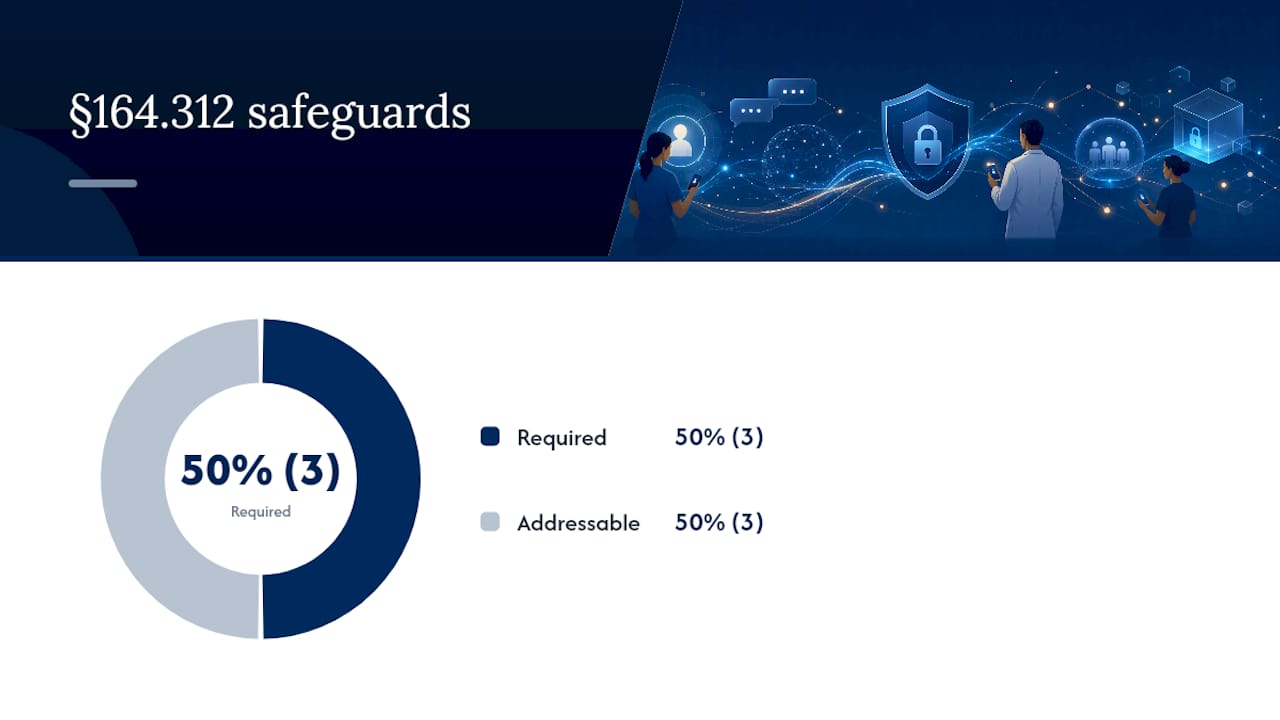
“Addressable” does not mean optional. It means you must implement the control or document a risk-based reason why an equivalent alternative is sufficient. In practice, encryption in transit and at rest is expected by every OCR auditor.
Device and session controls your platform must enforce:
- MFA on every clinician account
- Enforced session timeouts after a short period of inactivity are common policy benchmarks.
- Remote wipe capability for lost or stolen devices
- Mobile Device Management (MDM) or Enterprise Mobility Management (EMM) enrollment for any device that accesses the platform
Audit log requirements: Logs must capture sender identity, recipient, timestamp, and message metadata. Retain them long enough to support breach investigations consistent with the Security Rule’s documentation retention standard. Centralized log storage accelerates incident response and is one of the factors OCR reviews when evaluating organizational culpability.
Pro Tip: Run a quarterly review of your audit logs for anomalies: messages sent outside business hours, bulk sends to non-patient numbers, or access from unrecognized devices. Most breaches surface in the logs before they surface anywhere else.
4. What to require from texting vendors and how BAAs work
A vendor becomes your Business Associate the moment it creates, receives, maintains, or transmits PHI on your behalf. That triggers a mandatory signed BAA before any PHI flows through the platform. No BAA means no compliant texting, regardless of how good the vendor’s encryption is.
What the BAA must cover:
- Permitted uses and disclosures of PHI
- Obligation to use appropriate safeguards (encryption, access controls, audit logs)
- Breach reporting timeline: 60 days from discovery is the regulatory maximum; negotiate for shorter (24 to 48 hours for initial notification)
- Your right to audit the vendor’s security practices
- Subcontractor flow-down: the vendor must require its own subprocessors to sign equivalent BAAs
- Data deletion or return at contract termination, with a documented destruction certificate
Vendor procurement checklist:
- [ ] BAA signed before go-live
- [ ] Encryption confirmed: TLS 1.2+ in transit, AES-256 at rest
- [ ] SMS fallback disabled for PHI transmissions
- [ ] Role-based access controls and MFA available
- [ ] Audit logs exportable and retained per your policy
- [ ] Breach notification SLA documented in the BAA
- [ ] Subcontractor BAA flow-down confirmed in writing
- [ ] Data deletion/return clause with destruction certificate
Pro Tip: Request the vendor’s most recent SOC 2 Type II report and penetration testing summary before signing. A vendor that cannot produce either within 30 days of your request is a vendor whose security posture you cannot verify. Also confirm in writing that SMS fallback to carrier networks is disabled for any message that may contain PHI.
5. Patient rights, consent, and what §164.522 actually requires
Patients have more control over how you communicate with them than most providers realize. Privacy Rule §164.522 gives patients the right to request confidential communications by alternative means, including text message, when the request is reasonable. You must honor reasonable requests and document them.
What “reasonable” means in practice: A patient who asks to receive appointment reminders by text rather than phone call is making a reasonable request. You do not need to know why. You do need to record the preference, the date it was captured, and the channel through which it was collected.
Patient-initiated unencrypted texting: HHS guidance confirms that providers may accept patient-initiated unencrypted communications, including texts, when the patient has been warned about the risks of the channel and chooses to proceed. The key requirements:
- Deliver a clear risk warning (unencrypted texts can be intercepted or accessed by third parties)
- Document that the warning was given and the patient accepted the risk
- Record the date and method of consent in the EHR
- Limit your responses to the minimum necessary, even in a patient-initiated thread
Opt-in/opt-out capture in practice:
- Collect channel preference at intake, either on paper or through the patient portal
- Date- and time-stamp every preference record in the EHR
- Send a confirmation text when a patient opts in, so there is a message-level record
- Honor opt-out requests immediately and document the opt-out date
Sample opt-in confirmation text: “You’ve opted in to receive text messages from Riverside Clinic. We’ll send appointment reminders and logistical updates only. Reply STOP at any time to opt out. Standard message rates may apply.”
Sample risk warning for unencrypted texting: “Text messages are not encrypted and may be seen by others. By continuing this conversation, you acknowledge this risk and choose to communicate by text.”
Pro Tip: HIPAA consent for texting and TCPA consent for marketing texts are separate requirements. Capturing one does not satisfy the other. Cross-check your opt-in workflow against TCPA requirements to avoid a dual regulatory problem. A single intake form can capture both with the right language.
6. Operational policies: BYOD, clinical photos, and EHR-integrated messaging
Rules on paper do not protect patients. Operational guardrails do. The AMA recommends sanctioned, EHR-integrated secure messaging for clinical orders and urgent communications because integrated apps preserve audit trails and reduce clinician reliance on unsecured personal apps.
Policy essentials every organization needs:
- Approved use cases list: appointment reminders, logistical updates, secure portal redirects, and provider-to-provider clinical communications via approved apps only
- Prohibition list: consumer apps (WhatsApp, iMessage, standard SMS) for any PHI; screenshots of patient records; forwarding PHI to personal email or cloud storage
- Disciplinary steps: verbal warning for first offense, written warning for second, termination review for third, with immediate escalation for intentional disclosures
BYOD controls:
- MDM/EMM enrollment required before any personal device accesses PHI
- Enforced encryption on the device
- Remote wipe capability confirmed and tested annually
- Local backups to consumer cloud services (iCloud, Google Drive) disabled for work containers
Clinical photo guidance: UNC Health’s policy permits texting PHI for treatment among providers only via approved applications, with Epic Haiku and Vocera cited as examples. That is the right model. For clinical photos specifically:
- Use an EHR-integrated app (Epic Haiku) or an approved secure platform for wound photos, skin conditions, and other clinical images
- If a non-integrated method is unavoidable, de-identify the image before transmission (remove name, MRN, date of birth from any visible metadata or labels)
- Never store clinical photos in the device’s standard camera roll
Training and attestation cadence:
- Annual HIPAA training for all workforce members, with role-specific modules for clinical staff
- Documented acknowledgment of the texting policy at hire and annually thereafter
- Spot-check audits of message logs quarterly to verify policy adherence
Pro Tip: Shadow IT is the most common source of texting breaches. Clinicians default to personal apps because they are faster. The fix is not a stricter policy; it is a sanctioned app that is equally fast. Provide a mobile-optimized, EHR-integrated secure messaging tool and make it the path of least resistance. The AMA’s guidance on this point is direct: integrated apps reduce shadow IT and preserve the audit trail.
7. How texting breaches are evaluated and what penalties look like
OCR does not treat every texting incident the same way. Investigators weigh four factors: the nature and extent of the violation, the number of individuals affected, the organization’s prior compliance history, and what corrective action was taken before and after the incident.
Breach notification basics under the Breach Notification Rule:
-
Individual notice: required within 60 days of discovering a breach affecting 500 or more individuals, or within 60 days of year-end for smaller breaches
-
HHS notice: required within 60 days of discovery for breaches affecting 500 or more individuals; smaller breaches are reported annually
-
Media notice: required when a breach affects 500 or more residents of a state or jurisdiction
-
Did not know: lower tier, typically addressed through corrective action plans
-
Reasonable cause: mid-tier, corrective action plus potential civil monetary penalties
-
Willful neglect, corrected: higher tier with mandatory penalties
-
Willful neglect, not corrected: highest tier, maximum penalties per violation category
Texting breaches that follow a corrective action plan, demonstrate prior training, and show rapid containment consistently receive more favorable treatment than those where the organization had no documented policy and took no immediate action.
Immediate response timeline after a suspected texting breach:
- Within hours: contain the breach (revoke access, disable the compromised account or device)
- Within 24 hours: document what happened, which messages were involved, and how many individuals may be affected
- Within 72 hours: notify your Privacy Officer and legal counsel; begin the risk assessment
- Within 60 days: complete breach notification to affected individuals and HHS if thresholds are met
Pro Tip: Centralize your message logs and metadata in a single, searchable repository. When OCR requests records, the ability to produce complete logs within 48 hours signals organizational maturity and consistently reduces penalty exposure. Organizations that cannot produce logs face a harder investigation and a longer corrective action plan.
8. Allowed vs. prohibited messages: real examples and a decision checklist
The fastest way to train staff on HIPAA-compliant texting is concrete examples. Here is a side-by-side reference.
| Allowed | Prohibited |
|---|---|
| “Your appointment is Tuesday at 10 AM. Call 555-0100 to reschedule.” | “Your biopsy results are ready. Dr. Kim says it looks like early-stage melanoma.” |
| “Riverside Clinic: your prescription is ready for pickup.” | “Your metformin refill was denied. Your A1c is too high for the current dose.” |
| “You have a new message in your patient portal. Log in at [link].” | “Your HIV test came back negative. No follow-up needed.” |
| “Your referral to cardiology has been scheduled. We’ll send details by mail.” | “Dr. Reyes reviewed your chart. She recommends surgery. Call to discuss.” |
| Provider-to-provider via Epic Haiku: “Patient in room 4 needs cardiology consult, chest pain onset 2 hours ago.” | Same message sent via personal iMessage or standard SMS. |
Decision checklist before sending any text:
- Does this message contain a patient identifier combined with health, treatment, or payment information? If yes, use a BAA-covered platform or redirect to the portal.
- Is there a signed BAA with the platform carrying this message? If no, stop.
- Is the patient’s channel preference documented in the EHR? If no, collect it before sending.
- Does the message contain only the minimum necessary information? If no, redact before sending.
- Is SMS fallback disabled on this platform for PHI? Confirm before go-live.
Edge cases:
- Patient-initiated symptom descriptions: You may respond, but keep your reply to a secure portal redirect unless the patient has signed a documented risk acknowledgment for unencrypted texting.
- Clinical photos from patients: Receive them, but route them immediately into the EHR. Do not leave them in a standard SMS inbox.
- Family or caregiver communications: Require a signed authorization (HIPAA authorization or documented personal representative designation) before disclosing PHI to anyone other than the patient.
Safe fallback options when texting is not appropriate: secure patient portal message, phone call with identity verification, encrypted email with patient consent, or mailed correspondence.
9. Your step-by-step checklist for deploying secure texting
A compliant texting program requires organizational policy, vendor BAAs, technical configuration, device controls, workforce training, and incident response working together. Technology alone is not enough.
Numbered implementation checklist:
- Appoint or confirm your Security Official (required under the Security Rule). This person owns the texting compliance program.
- Conduct or update your risk analysis to include mobile messaging as a transmission vector. Document findings.
- Draft and publish your texting policy: approved use cases, prohibited behaviors, BYOD rules, clinical photo handling, and disciplinary steps.
- Select a vendor and execute the BAA before any PHI flows. Use the procurement checklist from Section 4.
- Configure technical controls: MFA, role-based access, session timeouts, SMS fallback disabled, audit logging enabled.
- Enroll devices in MDM/EMM and confirm remote wipe and encryption enforcement.
- Train all workforce members with role-specific modules. Document completion and attestation.
- Deploy opt-in/opt-out capture at intake and in the patient portal. Begin recording preferences in the EHR.
- Run a pilot with one department or location for 30 days. Review audit logs and incident reports.
- Phased rollout across remaining departments, with a compliance officer sign-off at each phase.
- Full production: monitor audit KPIs monthly.
- Post-deployment review at 90 days and annually, or after any incident or vendor change.
Suggested ownership and timeline:
- Weeks 1 to 2: Security Official, Privacy Officer, and legal counsel finalize policy and vendor BAA
- Weeks 3 to 4: IT configures platform and MDM; HR schedules training
- Week 5 to 6: Pilot department goes live; audit logs reviewed weekly
- Weeks 7 to 12: Phased rollout; opt-in capture active
- Month 4 onward: Full production with monthly KPI review
Audit KPIs to track:
- Percentage of outbound patient messages routed through BAA-covered platforms (target: 100%)
- Percentage of staff completing annual texting policy training (target: 100%)
- Number of patient opt-ins recorded in the EHR (track monthly growth)
- Mean time to contain a suspected texting incident (target: under 4 hours)
- Number of misdirected messages per quarter (target: zero; any nonzero triggers a process review)
What the compliance gap really costs you
Most providers understand that HIPAA violations carry financial penalties. Fewer appreciate that the operational cost of a texting breach, including staff time, legal fees, corrective action plan execution, and reputational damage, typically exceeds the monetary fine itself. The organizations that come through OCR investigations with the lightest outcomes share one characteristic: they had a documented, operational compliance program before the incident, not a policy document that no one had read.
The argument for EHR-integrated secure messaging is not primarily regulatory. It is operational. When clinicians have a fast, sanctioned tool, they use it. When they do not, they use iMessage. The AMA’s position is direct on this point: integrated apps reduce shadow IT and preserve the audit trail that protects both the patient and the organization.
Compliance officers sometimes focus on the policy document and underinvest in the tool. That is the wrong order of priority. A policy that prohibits consumer apps but provides no alternative is a policy that will be violated every shift. The implementation checklist in Section 9 is designed to close that gap: governance first, then the right tool, then training, then monitoring. Document every decision along the way. Auditors do not expect perfection; they expect evidence that you took the problem seriously.
Revring’s compliance infrastructure for healthcare communications
Healthcare operations that need to text patients at scale face a specific problem: most communication platforms were not built with HIPAA in mind, and retrofitting compliance onto a general-purpose tool is expensive and unreliable. Revring’s healthcare communications platform is built differently. BAA availability is standard, not an add-on. Role-based access controls, audit logging, and configurable session timeouts are part of the core infrastructure, not features you negotiate separately.
For compliance officers working through the implementation checklist above, Revring covers the vendor-side requirements directly: signed BAA before go-live, encryption in transit and at rest, SMS fallback controls, and exportable audit logs that meet Security Rule documentation standards. The platform also connects to CRM and workflow automation, so appointment reminders and patient communications run through a single, auditable pipeline rather than a patchwork of disconnected tools.

Ready to see how it fits your organization’s compliance requirements? Revring and bring your BAA checklist. The conversation starts there.
Sources
Every compliance program needs a short list of primary sources that auditors can verify. These are the ones that matter most for HIPAA texting rules.
Primary regulations and federal guidance:
Professional and institutional guidance:
Preserve these links in your policy documents. Auditors frequently ask for the regulatory citations underlying your texting policy. Having them embedded in the policy itself, with the CFR section numbers, demonstrates that the policy was written against primary authority rather than secondary summaries.
This article provides general compliance information, not legal advice. Verify current rules with HHS, your legal counsel, or a qualified HIPAA compliance professional before implementing a texting program.
This article is general information, not a substitute for advice from a qualified lawyer. Consult a qualified legal professional about your own circumstances before acting on anything here.