
HIPAA BAA Requirements: What Every Provider Must Know
HIPAA BAA Requirements: What Every Provider Must Know
If your vendor creates, receives, maintains, or transmits protected health information (PHI) on your behalf, you need a Business Associate Agreement (BAA), full stop. The controlling regulation is 45 CFR 164.504(e), and HHS/OCR guidance spells out exactly what belongs in that contract.
Every compliant BAA needs to nail down a handful of non-negotiables: permitted uses and disclosures of PHI, required safeguards under the Security Rule, breach and security incident reporting obligations, and a clear process for returning or destroying PHI when the relationship ends. Miss any of these, and you have a document that looks official but won’t hold up under an OCR investigation.
Here’s what to do right now. Pull up your vendor list and flag anyone who touches PHI, even briefly or indirectly. For every vendor on that list without a signed BAA mapped to 45 CFR 164.504(e), that’s your first compliance gap to close this week.
- Check access first, not just intent. A vendor doesn’t need to read PHI regularly to qualify as a business associate; persistent access is enough.
- Confirm the BAA covers safeguards, not just paperwork. Signing a BAA doesn’t verify a vendor’s actual security posture.
- Map every clause back to the regulation. If a BAA is missing breach notification timelines or return/destruction language, it’s incomplete regardless of how official it looks.
- Treat subcontractors as your problem too. If your business associate hands PHI to a subcontractor, that subcontractor needs its own BAA before anything moves downstream.
Key Takeaways
A BAA is legally required whenever a vendor creates, receives, maintains, or transmits PHI on a covered entity’s behalf, and it must satisfy the nine provisions defined under 45 CFR 164.504(e).
| Point | Details |
|---|---|
| Confirm the legal trigger | If a vendor has persistent access to PHI while performing services on your behalf, a BAA is required under 45 CFR 164.504(e). |
| Map all nine required provisions | Permitted uses, safeguards, breach reporting, subcontractor flow-down, and return/destruction terms must all appear explicitly. |
| Extend protections to subcontractors | Business associates must sign their own BAAs with any subcontractor before PHI moves downstream. |
| Don’t mistake a signature for security | A signed BAA creates legal obligations but doesn’t verify a vendor’s actual technical safeguards. |
| Use a platform to track vendor status | Tools like Revring centralize BAA tracking, renewal alerts, and role-based access for regulated healthcare operations. |
Table of Contents
- What Counts as a Business Associate Under HIPAA BAA Requirements
- When Is a BAA Legally Required, and What Falls Outside It?
- The HIPAA-Required BAA Elements Explained in Plain English
- Downstream BAAs: Managing Subcontractors and Flow-Down Obligations
- Breach Reporting and Business Associate Liability Under HITECH
- A Compliance Officer’s Checklist for Negotiating BAAs
- Common BAA Pitfalls and Red Flags to Watch For
- Authoritative Resources and a One-Page BAA Checklist
- What I’d Prioritize First if I Ran Compliance for a Growing Practice
- Simplify Vendor Compliance With a Platform Built for Regulated Industries
- Primary Sources for Citation and Policy Reference
- Frequently Asked Questions About HIPAA BAA Requirements
- Sources
What Counts as a Business Associate Under HIPAA BAA Requirements
A business associate is any person or entity that performs functions or activities on behalf of a covered entity, or another business associate, that involve creating, receiving, maintaining, or transmitting PHI. HHS defines this broadly on purpose. The government wants coverage to follow the data, not the org chart.
Covered entities are the healthcare providers, health plans, and healthcare clearinghouses that generate PHI in the first place. Think of a dermatology practice, a third-party insurer, or a hospital billing department. Business associates are everyone else who touches that data to help the covered entity function: billing companies, medical transcription services, IT contractors managing electronic health records, and cloud storage providers.
The trigger isn’t how often a vendor looks at PHI. It’s whether they have the capability to access it while performing a service for you. This is where healthcare providers get tripped up most often.
Persistent access changes everything. A cloud service provider hosting your patient records is a business associate even if the data is encrypted and you control the encryption keys. HHS guidance is explicit on this point: a covered entity using a cloud provider without a signed BAA is in violation of HIPAA regulations, regardless of what marketing language the provider uses about being “HIPAA compliant.” Vendors sometimes claim compliance without actually offering a BAA, and that gap is exactly what gets practices fined.
Common business associate relationships in healthcare include:
- Billing and claims processing companies handling patient account data
- Medical transcription services converting dictated notes into records
- Cloud storage and backup providers hosting electronic health records
- Analytics vendors processing disidentified or identifiable patient data
- IT support contractors with remote access to systems containing PHI
- Answering services and call centers that field patient calls involving PHI
Not every vendor relationship creates a business associate arrangement, though. Workforce members, including employees and volunteers under your direct control, are not business associates because they’re covered by their own workforce agreements, not a separate contract. Entities exchanging PHI purely for treatment, payment, or health care operations, like a specialist receiving records from a primary care doctor to treat the same patient, generally fall outside BA status too. Vendors with only incidental contact, like a janitorial service that might glimpse a chart on a desk, typically don’t need a BAA either, because PHI access isn’t part of the service they’re contracted to provide.
Here’s the quick decision rule compliance officers should use: does the vendor need to access PHI to do their job? Is that access ongoing rather than accidental? Are they acting on your behalf, or simply exchanging information as part of patient care? If the answers point toward “yes, ongoing, on our behalf,” you need a BAA.
When Is a BAA Legally Required, and What Falls Outside It?
The legal trigger for a BAA is straightforward: PHI is disclosed to a vendor performing services on behalf of a covered entity, or on behalf of another business associate. That’s the standard set out in 45 CFR 164.504(e), and it applies whether the vendor is a Fortune 500 software company or a two-person transcription shop.
The subcontractor rule extends this obligation down the chain. If your business associate needs to bring in a subcontractor, that subcontractor must sign its own BAA before any PHI moves their direction, and HHS requires that subcontractor to meet security and privacy standards equal to or stricter than the original agreement. There’s no “grandparent exception” here. Every link in the chain needs its own contract.
Run through this ordered checklist to classify any vendor relationship quickly:
- Does the vendor create, receive, maintain, or transmit PHI in the course of the service they provide? If no, stop here. No BAA needed.
- Is that access persistent or ongoing, rather than a one-time accidental exposure? Occasional incidental contact (a courier who might see a label) generally doesn’t trigger BA status.
- Is the vendor performing this function on your behalf, or are they a fellow provider exchanging information for treatment purposes? Treatment, payment, and health care operations exchanges between providers typically don’t require a BAA.
- Will this vendor bring in subcontractors to help deliver the service? If yes, plan for a flow-down BAA before any data reaches that subcontractor.
- Has legal or compliance reviewed the specific scope of services against the regulatory definition? Don’t rely on the vendor’s own marketing claims about HIPAA compliance.
Borderline cases deserve extra scrutiny. A health plan sharing claims data with a provider for coordination of care usually doesn’t need a BAA between them, since that’s a treatment/payment/operations exchange. But the moment either party brings in a third-party analytics firm to process that same data for reporting purposes, a BAA becomes necessary for that vendor relationship. The distinction is subtle but matters enormously for audit purposes: experts caution against insisting every contractor sign a BAA regardless of whether they actually handle PHI, since unnecessary agreements add legal complexity and can create liability where none previously existed.
The HIPAA-Required BAA Elements Explained in Plain English
The regulatory backbone for every BAA sits in 45 CFR 164.504(e), and HHS provides sample provisions that map directly to these requirements. A HIPAA-compliant BAA needs nine core provisions, and each one solves a specific compliance problem.
| Regulatory Element | Plain-English Meaning | Sample Clause Prompt |
|---|---|---|
| Permitted uses and disclosures | Defines exactly what the business associate can and cannot do with PHI. | “Business Associate shall use or disclose PHI only as necessary to perform the services described in Exhibit A, and shall not use PHI for any purpose not permitted by this Agreement.” |
| Prohibition on further use | Blocks the vendor from using PHI beyond the agreed scope, including for their own marketing or product development. | “Business Associate shall not use PHI for any purpose other than as expressly permitted herein, including identification or aggregation, without prior written authorization.” |
| Appropriate safeguards | Requires administrative, physical, and technical protections consistent with the Security Rule. | “Business Associate shall implement administrative, physical, and technical safeguards that reasonably and appropriately protect the confidentiality, integrity, and availability of ePHI.” |
| Reporting of security incidents and breaches | Obligates the vendor to notify you of any security incident or breach of unsecured PHI. | “Business Associate shall report to Covered Entity any Security Incident or Breach of Unsecured PHI within [X] business days of discovery.” |
| Subcontractor flow-down | Requires the vendor to bind any subcontractors to the same or stricter obligations. | “Business Associate shall ensure that any subcontractor that creates, receives, maintains, or transmits PHI on its behalf agrees, in writing, to the same restrictions and conditions.” |
| Access, amendment, and accounting support | Requires the vendor to help you respond to patient requests for access, amendments, or an accounting of disclosures. | “Business Associate shall make PHI available to Covered Entity as necessary to satisfy obligations under the applicable provisions of 45 CFR.” |
| Availability for audit and compliance review | Requires the vendor to make its books and practices available to HHS upon request. | “Business Associate shall make its internal practices, books, and records relating to the use and disclosure of PHI available to the Secretary of HHS for compliance determination.” |
| Return or destruction of PHI at termination | Requires the vendor to return or destroy all PHI when the contract ends, or explain why that’s infeasible. | “Upon termination of this Agreement, Business Associate shall return or destroy all PHI received from Covered Entity, or, if return or destruction is infeasible, extend protections to the PHI and limit further uses.” |
| Termination rights for material breach | Gives the covered entity authority to terminate the contract if the business associate materially violates its terms. | “Covered Entity may terminate this Agreement immediately if Business Associate has violated a material term and cured breach is not feasible within [X] days.” |
Each of these provisions exists because a real-world gap created a real-world problem for patients or providers. The subcontractor flow-down clause, for instance, closes the loophole where a compliant business associate quietly outsources data handling to an uncontrolled third party. The return-or-destruction clause protects you when a vendor relationship ends but their server still has years of patient records sitting on it.
Draft language should always be customized to the specific services a vendor provides. A transcription service and a cloud infrastructure provider face different risk profiles, and your safeguards language should reflect that rather than using one generic template for every vendor.
Downstream BAAs: Managing Subcontractors and Flow-Down Obligations
Your business associate’s subcontractors are your risk too, even though you never sign anything directly with them. Under HHS guidance, a business associate must enter into a BAA with any subcontractor before disclosing PHI, and that subcontractor agreement must hold the subcontractor to security and privacy standards at least as strict as the original BAA.

This becomes complicated fast in modern healthcare IT stacks. A single cloud-based EHR platform might rely on a hosting provider, a backup service, an analytics layer, and a customer support tool, each one a potential subcontractor with its own access to PHI. If any link in that chain lacks a proper BAA, the entire arrangement is out of compliance, and you’re the one who bears reputational and regulatory fallout even though the failure happened two steps removed from your desk.
Common subcontractor chains that create real risk include:
- Cloud storage vendors who subcontract backup or disaster recovery to a separate infrastructure provider
- Analytics platforms that route data through third-party machine learning services for processing
- Transcription services that use offshore contractors for overflow work
- Answering services that integrate with separate scheduling or notification platforms
When drafting flow-down language, your primary BAA should explicitly require the business associate to obtain satisfactory assurances from every subcontractor in writing, and to notify you if a new subcontractor is added mid-contract. For vendors handling especially sensitive data categories, like behavioral health records or genetic information, push for more stringent controls than the baseline. That might mean requiring encryption at rest and in transit, mandatory security incident notification within 24 hours instead of the standard 10 business days, or a right to audit the subcontractor directly.
Operational controls matter as much as contract language here. Build a vendor inventory that tracks every subcontractor relationship your primary business associates rely on, not just your direct vendors. Apply least-privilege access principles so subcontractors only see the minimum PHI necessary for their function. Require annual attestations confirming subcontractor BAAs remain in force, and request security questionnaires or SOC 2 reports as supporting evidence rather than taking a vendor’s word for it. Schedule periodic reviews, at least annually, to confirm the subcontractor chain hasn’t changed without your knowledge.
Breach Reporting and Business Associate Liability Under HITECH
Business associates carry direct legal liability for HIPAA violations, a fact that surprises providers who assume liability stops with the covered entity. The 2013 HITECH Act final rule changed the enforcement landscape permanently: OCR can now investigate and fine business associates directly, not just the covered entities who hired them.
Your BAA should require the business associate to report any security incident they become aware of, including breaches of unsecured PHI, back to you as specified in the Security Rule. This obligation exists independent of the Breach Notification Rule’s own reporting timelines, which generally require notification to affected individuals within 60 days of discovery. Business associates are also directly liable for failing to safeguard ePHI properly and for failing to provide electronic copies of PHI when a patient requests them, though the reasonable cost-based fee for producing those copies stays the covered entity’s responsibility.
When a breach happens, here’s a practical incident-response sequence tied to standard contract obligations:
- Contain the incident immediately. Stop further exposure before anything else.
- Notify the covered entity per the contractual timeline. Most BAAs specify a window, often 24 to 72 hours, for the business associate to alert you.
- Conduct a forensic review to determine scope. How many records, what data types, how long was the exposure open?
- Coordinate joint communication. Decide who notifies affected patients, and confirm the business associate covers costs if the breach originated on their end.
- Document remediation steps. OCR will ask what changed after the incident, not just what happened.
The single most important operational takeaway: don’t wait for a breach to discover your BAA’s reporting timeline is vague. Confirm the exact notification window in writing before you sign, and escalate to legal immediately if a vendor pushes back on specific deadlines.
A Compliance Officer’s Checklist for Negotiating BAAs
Evaluating and approving a BAA shouldn’t be a rubber-stamp exercise. Treat it as a structured procurement decision with real negotiation leverage.
- Collect pre-signing documentation. Request the vendor’s most recent risk assessment, a summary of their encryption practices for data at rest and in transit, and any SOC 2 Type II reports covering the relevant time period.
- Confirm the vendor’s security posture matches their marketing claims. A vendor advertising “bank-level encryption” should be able to name the actual standard they use (AES-256 is the common benchmark).
- Negotiate minimum-security language into the contract itself. Don’t accept vague promises to “maintain reasonable safeguards.” Specify encryption standards, access control requirements, and multifactor authentication where applicable.
- Secure audit rights. You should have contractual authority to request evidence of compliance, not just a signed document that says the vendor complies.
- Address indemnity and liability carve-outs explicitly. Determine who bears financial responsibility if the vendor’s negligence causes a breach.
- Nail down breach notification timelines in hours or days, never “promptly” or “as soon as reasonably possible.” Vague language here creates disputes exactly when you can least afford them.
- Confirm termination rights allow immediate contract exit for material breach. You need the ability to cut ties fast if a vendor’s security posture deteriorates.
- Specify return or destruction language with a hard deadline. Thirty days post-termination is a common standard; open-ended timelines invite risk.
- Route the final document through legal review before signature, even if you’re using a standardized BAA addendum, since vendor-specific service scopes can create gaps a generic template misses.
- Track renewal and expiration dates in a centralized system, not a filing cabinet, so an expired BAA never remains silently active while data keeps flowing.
Pro Tip: Escalate to legal whenever a vendor’s service scope includes AI processing, offshore data handling, or any subcontractor relationship you can’t fully map. A standard BAA addendum works fine for routine vendors like transcription services, but AI-driven platforms and multinational cloud providers often need custom safeguards language that a template can’t anticipate.
Common BAA Pitfalls and Red Flags to Watch For
The single most damaging assumption in healthcare compliance is treating a signed BAA as proof that a vendor is actually secure. It isn’t. A BAA is a legal obligation, not a technical audit, and the vendor still has to implement real administrative, physical, and technical safeguards independent of what the paper says.
Watch for these red flags in contract language:
- Overbroad permitted-use clauses that let the vendor use PHI for “any business purpose,” which can quietly authorize product development or marketing uses you never intended.
- Missing subcontractor flow-down language, which leaves you exposed the moment the vendor brings in outside help without your knowledge.
- Vague breach notification timelines using words like “promptly” instead of a specific number of hours or days.
- Weak return/destruction obligations that don’t specify a deadline or don’t cover backup copies and archived data.
- No audit or cooperation clause, meaning you have no contractual right to verify the vendor’s claims after signing.
Operational missteps compound these contract-level problems. Many compliance teams never build a complete vendor inventory, so they don’t even know which relationships require a BAA in the first place. Expired BAAs frequently remain active in practice because no one tracks renewal dates. And it’s common to conflate a “business associate” with any vendor who simply receives an invoice or a service request, when the actual legal test is whether PHI is created, received, maintained, or transmitted on your behalf.
The corrective move for each of these: request narrower permitted-use language tied specifically to the contracted service, insist on defined breach timelines in hours rather than vague adverbs, and build a standing audit clause into every new BAA regardless of vendor size. A cloud provider offering document management or storage services should be able to speak fluently about their encryption architecture and access controls without prompting. If they can’t, that’s your red flag before you’ve even reviewed the contract.
Authoritative Resources and a One-Page BAA Checklist
Every compliance file should reference primary sources directly, not secondhand summaries. Bookmark these for your policy documentation:
- HHS sample BAA provisions, the government’s own template language for the nine required elements
- HHS Business Associates guidance page, covering definitions, subcontractor rules, and scope
- 45 CFR §164.504(e) and §164.314, the regulatory text establishing organizational requirements for business associate contracts
- HITECH Act business associate factsheet, explaining direct liability and enforcement authority
- Business Associates FAQ, addressing specific scenarios like cloud service providers and persistent access
Your one-page checklist for any new vendor relationship should confirm: the vendor’s service scope requires PHI access; a signed BAA is in place mapped to 45 CFR 164.504(e); permitted uses are narrowly defined; safeguards language specifies encryption and access controls; breach notification has a specific timeline; subcontractor flow-down is addressed; return/destruction terms specify a deadline; and the agreement is logged in a centralized tracking system with a renewal date.
Templates save time, but they’re a starting point, not a finish line. Every vendor relationship carries different risk depending on data volume, service scope, and subcontractor chains. Bring legal into the review for any nonstandard service, particularly AI-driven tools or offshore vendors where enterprise-grade compliance practices vary widely.
What I’d Prioritize First if I Ran Compliance for a Growing Practice
Most compliance teams try to solve BAA management by chasing signatures. That’s backward. The first move should always be building a complete vendor inventory, because you can’t protect what you haven’t identified. I’ve seen practices with dozens of “shadow vendors,” tools staff adopted without procurement’s knowledge, sitting completely outside any compliance review.
Once the inventory exists, prioritize BAAs for your highest-risk vendors first: anyone with persistent, automated access to PHI, especially cloud infrastructure and AI-driven analytics tools. Lower-risk vendors, the ones with occasional or narrowly scoped access, can follow on a slower timeline. Trying to negotiate every BAA simultaneously burns legal resources you’ll need for the vendors that actually matter.
The friction point I see most often isn’t the legal language. It’s the disconnect between legal, IT, and procurement teams operating on separate tracks. Procurement signs a vendor contract before compliance even knows the tool exists. IT grants system access before legal has reviewed the BAA. Fixing this requires a shared intake process where no new vendor gets system access until compliance has confirmed BA status and, if needed, a signed agreement is on file.
One thing worth remembering: a BAA is a foundational legal control, but it doesn’t verify anything about a vendor’s actual security implementation. HHS itself confirms that covered entities aren’t required to monitor a business associate’s day-to-day compliance once a proper contract is in place, but skipping pre-signing due diligence entirely is how practices end up with a legally sound BAA sitting on top of a genuinely insecure vendor. The contract protects you legally. It doesn’t protect your patients technically. Those are two different jobs, and treating them as one is the most common blind spot I encounter in this work.
Simplify Vendor Compliance With a Platform Built for Regulated Industries
Chasing down BAA status across dozens of vendors, tracking renewal dates in a spreadsheet, and hoping IT flags new system access before compliance signs off is how gaps happen. Revring builds compliance infrastructure directly into its platform for healthcare, insurance, and other regulated industries, including HIPAA BAA tracking alongside TCPA and DNC controls, so your vendor inventory and contract status live in one place instead of scattered across email threads and shared drives.
If you’re evaluating any vendor claiming “HIPAA support,” ask three questions before you sign anything: will they actually execute a BAA, not just reference one in marketing copy? Does their access to PHI persist beyond a single transaction? Can they specify their encryption standard in plain terms? A platform’s healthcare-specific features should support role-based access, document attachment for signed BAAs, and renewal alerts so an expired agreement never quietly stays active. Demand a signed BAA regardless of how confidently a vendor talks about compliance, and check Revring’s pricing if you’re ready to see how a unified compliance and calling platform fits your practice’s vendor management needs.
Primary Sources for Citation and Policy Reference
- HHS sample BAA provisions, the government’s template for the nine required contract elements
- HHS Business Associates guidance, covering definitions, scope, and subcontractor requirements
- 45 CFR §164.504(e) and §164.314, the regulatory text governing business associate contract requirements
- HITECH Act business associate factsheet, detailing direct liability and OCR enforcement authority
- Business Associates FAQ, addressing cloud service providers and specific compliance scenarios
When citing these in internal policy documents, reference the specific CFR section number alongside the HHS guidance page, since auditors and legal reviewers expect both the regulatory citation and the interpretive guidance side by side.
Frequently Asked Questions About HIPAA BAA Requirements
Do I need a BAA for every vendor who touches patient data in any way?
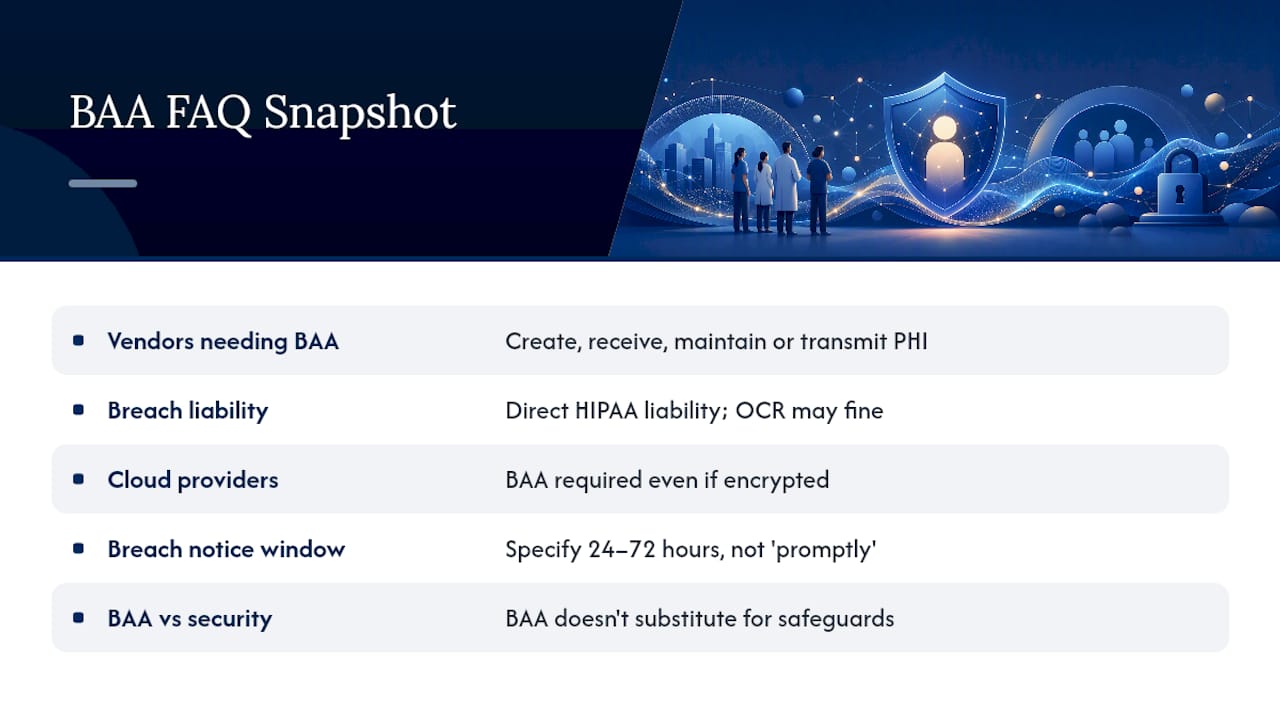
No. Only vendors who create, receive, maintain, or transmit PHI while performing a service on your behalf need a BAA. Vendors with only incidental contact, like a maintenance contractor who might glimpse a filing cabinet, generally fall outside this requirement.
What happens if a business associate causes a breach?
Since the HITECH Act final rule, business associates face direct liability for HIPAA violations. OCR can investigate and fine the business associate directly, separate from any action taken against the covered entity.
Does a cloud storage provider need a BAA even if the data is encrypted?
Yes. HHS guidance confirms that cloud service providers with persistent access to PHI must have a BAA, even when the covered entity holds the encryption keys. Encryption doesn’t remove the requirement.
How long should a vendor have to notify us of a breach?
Your BAA should specify a concrete window, commonly 24 to 72 hours, rather than vague language like “promptly.” Specific deadlines prevent disputes during an actual incident.
Can a signed BAA substitute for verifying a vendor’s security practices?
No. A signed BAA is a legal obligation, not a technical guarantee. The vendor still needs to implement administrative, physical, and technical safeguards independently, and requesting SOC 2 reports or security questionnaires remains a sound due-diligence practice.
Is a BAA required between two covered entities exchanging records for patient treatment?
Generally, no. Exchanges between providers for treatment, payment, or health care operations purposes typically don’t create a business associate relationship, since neither party is performing a function on behalf of the other in the regulatory sense.
This information is provided for general guidance and does not substitute for advice from a qualified healthcare attorney or compliance professional familiar with your specific vendor relationships and organizational structure.
This article is general information, not a substitute for advice from a qualified lawyer. Consult a qualified legal professional about your own circumstances before acting on anything here.
Sources
- Business Associate Contracts
- Business Associates (HHS)
- Business Associates | HHS.gov
- Business Associate factsheet (HHS)
- Hipaajournal